Local Guide
Places of Worship in Kampong Glam, Singapore
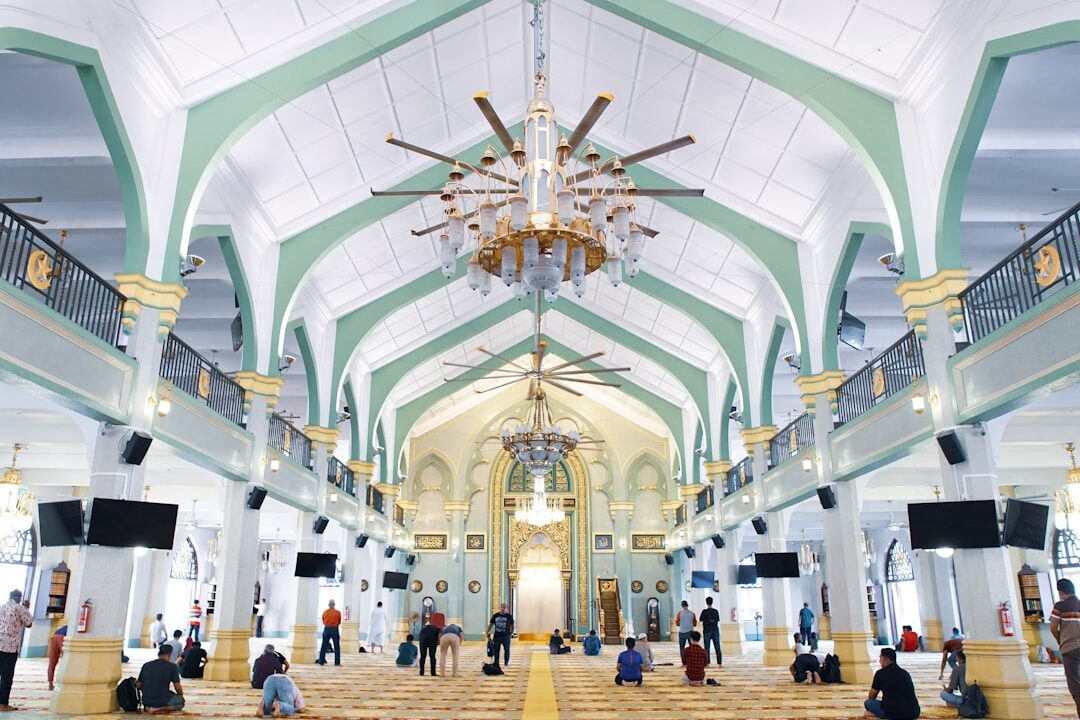
Kampong Glam is Singapore’s historic Malay-Muslim quarter, a compact grid of shophouse-lined lanes just north-east of the city centre. Once the seat of Malay royalty, the district today balances heritage and street life: textile merchants along Arab Street, cafes and boutiques on Haji Lane, and the perfume traders of Bussorah Street. At its heart stands the golden-domed Sultan Mosque, one of the most recognisable landmarks in the country. This guide covers the district’s principal places of worship, how to reach them, and how to visit respectfully.
Because Kampong Glam grew up around the palace of Sultan Hussein Shah, its religious architecture is overwhelmingly Islamic, but the surrounding Bras Basah and Bugis fringe adds churches and other faiths within a short walk. Together they make this one of the richest religious-heritage trails in Singapore. For the full picture across the island, see our places of worship in Singapore hub.
Sultan Mosque: the golden-domed heart of the quarter
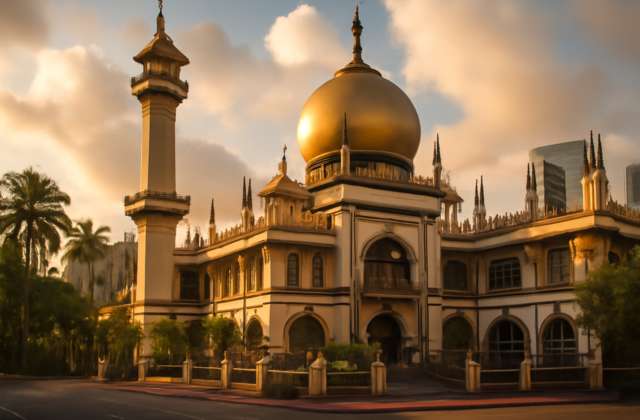
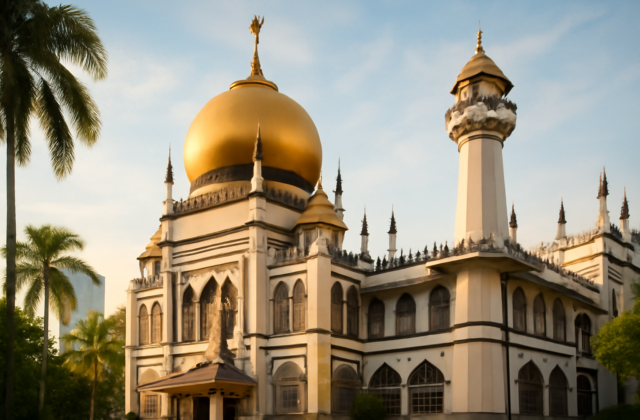
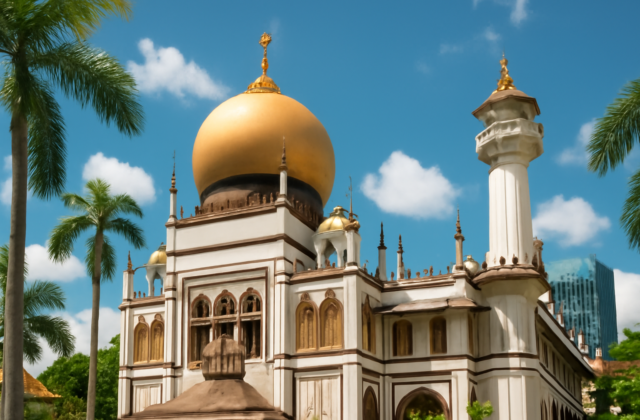
The Sultan Mosque (Masjid Sultan) is the anchor of Kampong Glam and a National Monument. The original mosque was built in the 1820s with a grant from the East India Company after the founding treaty with Sultan Hussein. The grand building seen today, with its massive golden onion domes and prayer hall for thousands of worshippers, dates from the 1920s and was designed in an Indo-Saracenic style by the architectural firm Swan and Maclaren. Look closely at the base of the domes: dark bands made from the ends of glass bottles, said to have been donated by poorer members of the congregation so that everyone had a hand in building the mosque.
Standing at the end of Bussorah Street, the mosque is best viewed along that pedestrianised promenade, which frames the domes beautifully for photographs. It remains an active mosque and the focal point of community life in the quarter, especially during Ramadan, when the surrounding streets fill with a lively evening bazaar.
Heritage mosques nearby: Malabar and Hajjah Fatimah
A few minutes’ walk from Sultan Mosque, Masjid Malabar stands on the corner of Victoria Street and Jalan Sultan. Founded by the Malabar Muslim community of South India, it is instantly identifiable by its striking blue-and-white geometric tiles that clad the entire exterior, giving it the popular nickname “the blue mosque”. Completed in stages over several decades, it is one of the most photogenic mosques in the district and a quieter alternative to the busier Sultan Mosque.
To the east, near Beach Road, the Hajjah Fatimah Mosque is another National Monument and one of the few mosques in Singapore named after a woman. A wealthy Malay businesswoman of Malacca origin, Hajjah Fatimah funded its construction in the 1840s on the site of her former home. Its most curious feature is the leaning minaret, which tilts several degrees off vertical, earning it comparisons to the Leaning Tower of Pisa. The design blends European, Malay and Chinese influences, reflecting the cosmopolitan port city of its day. You can explore more houses of worship in our mosques directory.
The Bras Basah and Bugis edge: Bencoolen and St Joseph
Walk south-west towards the Bras Basah and Bugis area and the religious mix broadens. Masjid Bencoolen on Bencoolen Street has one of the most unusual profiles of any mosque in Singapore: rather than a standalone heritage building, it was rebuilt as a slim, modern tower integrated with residential apartments above, while preserving its long history as a place of worship dating back to the early 19th century. It serves the working population of the city fringe and shows how faith spaces adapt to a dense urban setting.
Close by on Victoria Street is the Church of St Joseph, a Roman Catholic church of Portuguese Mission heritage. This Gothic-style building, another National Monument, is known for its stained-glass windows and its Good Friday processions, which draw large crowds each year. Its presence a short stroll from the mosques of Kampong Glam is a neat illustration of the religious diversity packed into this corner of the city.
Getting there: nearest MRT and the Arab Street context
The most convenient access point is Bugis MRT station, served by the East West Line and the Downtown Line. From Bugis it is a short walk north to Arab Street and the entrance to the quarter. Nicoll Highway and Lavender stations are useful alternatives for the Beach Road side and Hajjah Fatimah Mosque, while Bras Basah and Bencoolen stations sit closest to Masjid Bencoolen and the Church of St Joseph.
The mosques are woven directly into the district’s retail heart. Arab Street is lined with textile, carpet and rattan shops, while Haji Lane, one of Singapore’s narrowest streets, is packed with independent boutiques, murals and bars. This means a visit to the places of worship pairs naturally with browsing, coffee or a meal, and the area is easily covered on foot in an afternoon.
Visiting etiquette for mosques
Non-Muslim visitors are welcome at the mosques of Kampong Glam outside of prayer times, and Sultan Mosque in particular has designated visiting hours and a reception desk with volunteers who can answer questions. A few simple courtesies apply. Dress modestly: shoulders and knees should be covered, and many mosques provide loan robes at the entrance for those who need them. Remove your shoes before entering the prayer hall. Speak quietly, switch phones to silent, and always ask before photographing worshippers. During the five daily prayers and the main Friday congregational prayer, the halls are reserved for worshippers, so plan to visit between these times. The same principles of modest dress and quiet respect apply at the Church of St Joseph and other faith sites in the area.
Frequently asked questions
What is the most famous mosque in Kampong Glam?
The Sultan Mosque (Masjid Sultan) is the best known, recognisable by its large golden domes and its position at the head of Bussorah Street. It is a National Monument and the focal point of the quarter.
Which MRT station is closest to Kampong Glam?
Bugis MRT, on the East West and Downtown Lines, is the nearest and most convenient station, a short walk from Arab Street and Sultan Mosque.
Can non-Muslims enter the mosques?
Yes. Non-Muslim visitors are welcome outside prayer times. Dress modestly with shoulders and knees covered, remove your shoes before entering the prayer hall, and keep noise to a minimum. Robes are usually available to borrow at the entrance.
Which mosque has the blue tiles?
Masjid Malabar, at the corner of Victoria Street and Jalan Sultan, is clad in distinctive blue-and-white geometric tiles and is often called the blue mosque.
Are there non-Muslim places of worship nearby?
Yes. On the Bras Basah and Bugis fringe you will find the Roman Catholic Church of St Joseph on Victoria Street, within easy walking distance of the mosques.