Local Guide
Places of Worship in Little India, Singapore
Few corners of Singapore pack as much religious life into so short a walk as Little India. Strung along Serangoon Road and its side lanes, you can pass a garlanded Hindu temple, a filigreed mosque, a Buddhist hall and a Methodist church within minutes of one another — a genuine multi-faith trail that reflects the mixed migrant community who settled here. This guide maps the district’s most significant places of worship, tells you which MRT station to alight at, and sets out the etiquette that keeps a visit respectful. Each listing links through to our directory for addresses, opening hours and contact details.
For the bigger picture, see our hub on places of worship in Singapore, or browse the full places of worship directory.
Hindu temples along Serangoon Road
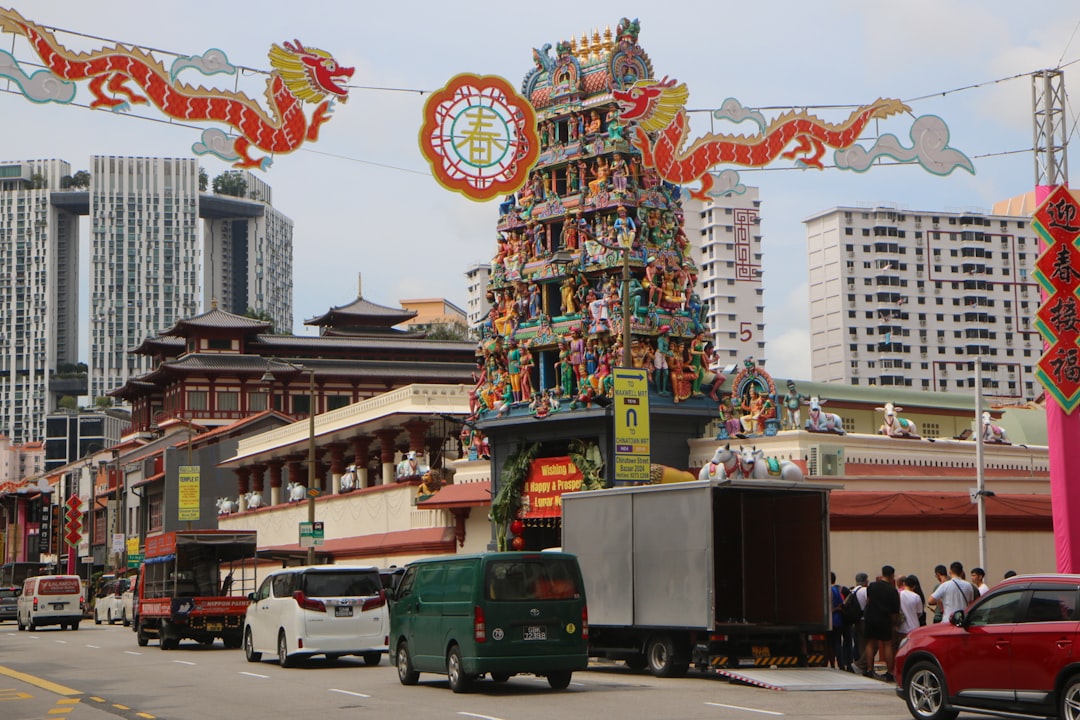
The Hindu temples are the heart of Little India, their gopuram towers crowded with brightly painted deities. The oldest is Sri Veeramakaliamman Temple, dedicated to the fierce goddess Kali and dating to the 1880s, when it served the district’s Bengali labourers and cattle traders. A short walk north stands Sri Srinivasa Perumal Temple, a national monument devoted to Vishnu and best known as the starting point of the annual Thaipusam procession, when devotees carry ornate kavadi to the temple in Tank Road. Nearby, Sri Vadapathira Kaliamman Temple is admired for its especially elaborate sculptural detail and gilded interior. All three are busiest during Deepavali, when Serangoon Road itself is strung with lights.
Mosques of the district
Little India’s mosques served its Muslim traders and Tamil-Muslim community. The most beautiful is Abdul Gafoor Mosque on Dunlop Street, a national monument that blends Indo-Saracenic and Victorian styles, with a striking sunburst sundial above its main entrance. On Serangoon Road itself, Masjid Angullia is a long-standing neighbourhood mosque endowed by an early Gujarati merchant family. Both hold the five daily prayers and the Friday congregational prayer (Jumu’ah); visitors are welcome outside prayer times but should check before entering the prayer hall.
Buddhist temples on Race Course Road
Parallel to Serangoon Road, Race Course Road hosts two well-loved Buddhist temples. Sakya Muni Buddha Gaya — universally known as the Temple of 1000 Lights — is dominated by a 15-metre seated Buddha ringed by hundreds of electric bulbs, founded by a Thai monk and reflecting a Theravada tradition unusual in Singapore. A few doors away, Leong San See Temple (the “Dragon Mountain” temple) is a graceful Chinese Buddhist and Taoist temple honouring the Goddess of Mercy, Guan Yin, with finely carved beams and a quiet courtyard. The pairing is a neat reminder of how many traditions share these few streets.
Churches in Little India
The district’s churches trace the arrival of Chinese Methodist congregations in the early 20th century. Kampong Kapor Methodist Church, with its distinctive curved Art Deco frontage, grew out of Peranakan and Straits Chinese worship and remains a landmark on Kampong Kapor Road. Close by, Foochow Methodist Church serves the Foochow (Fuzhou) community and holds services in several languages. Both welcome visitors to Sunday worship.
The Waterloo Street edge
On the southern fringe of the district, pedestrianised Waterloo Street offers perhaps the most concentrated interfaith stretch in Singapore. Standing almost side by side are Sri Krishnan Temple, a Hindu temple dedicated to Krishna, and Kwan Im Thong Hood Cho Temple, one of the island’s most-visited Buddhist temples devoted to Guan Yin. Remarkably, many devotees pray at both — a much-photographed example of Singapore’s everyday religious harmony. A little further along the same street is Maghain Aboth Synagogue, a national monument and the oldest surviving synagogue in Southeast Asia, serving Singapore’s long-established Jewish community. Visits to the synagogue are usually arranged in advance for security reasons.
Getting there by MRT
The area is exceptionally well served by rail, so most sites are an easy walk from a station:
- Little India MRT (North East and Downtown lines) — closest to Sri Veeramakaliamman, Abdul Gafoor Mosque and the Dunlop Street lanes.
- Farrer Park MRT (North East line) — the handiest stop for Sri Srinivasa Perumal, the Race Course Road temples and the northern end of Serangoon Road.
- Rochor MRT (Downtown line) — nearest to the Waterloo Street cluster of Sri Krishnan, Kwan Im Thong Hood Cho and Maghain Aboth Synagogue; Bras Basah and Bugis stations are also within walking distance.
Because the temples, mosques and churches sit so close together, many visitors simply alight at Little India and walk the length of Serangoon Road on foot.
Visiting etiquette
These are active houses of worship as well as heritage sites, so a few courtesies apply across faiths:
- Dress modestly — cover shoulders and knees. Some temples and mosques provide shawls or robes at the entrance.
- Remove your shoes before entering Hindu and Buddhist temples, mosques and the synagogue; leave them at the racks provided.
- Cover your head where asked — mosques and the synagogue expect this; scarves are often available to borrow.
- Ask before photographing people at prayer, and switch off flash near shrines and murals.
- Keep quiet and unobtrusive during prayers, aarti or services, and follow any signs on where visitors may go.
- Time your visit — festivals such as Thaipusam and Deepavali are spectacular but extremely crowded, so plan accordingly.
Frequently asked questions
What is the most famous temple in Little India?
Sri Veeramakaliamman Temple on Serangoon Road is the best known and one of the oldest, dedicated to the goddess Kali. Sri Srinivasa Perumal Temple is also widely visited as the start of the Thaipusam procession.
Which MRT station is best for Little India’s places of worship?
Little India MRT is central and closest to the main Serangoon Road temples and Abdul Gafoor Mosque. Use Farrer Park for the Race Course Road temples and Rochor for the Waterloo Street cluster.
Can non-worshippers visit the temples and mosques?
Yes. Most welcome respectful visitors outside of prayers and services. Dress modestly, remove your shoes where required, and ask before taking photographs.
Is there really a synagogue in the area?
Yes — Maghain Aboth Synagogue on Waterloo Street is a national monument and the oldest surviving synagogue in Southeast Asia. Visits are generally arranged in advance.
When is the best time to see Little India’s temples at their liveliest?
During Deepavali, when Serangoon Road is lit up, and during Thaipusam, when devotees process from Sri Srinivasa Perumal Temple. Both are memorable but very busy.