
Local Guide
Best Violin Lessons in Singapore (2026 Guide)
Choosing violin lessons in Singapore is less about hunting for one celebrated teacher and more about matching the right format, level and budget to the student. This is an editorial “how to choose” guide rather than a ranking of schools: it sorts your options by lesson format, the age and stage of the learner, exam pathways and price tier so you can decide what truly fits. The violin is an unforgiving instrument with no frets to guide intonation, so the early choices you make about teacher and format matter more here than with many other instruments. Use the questions below before you commit.
Note: we deliberately do not name specific private teachers or music schools. Studios open, rebrand and shift premises often, and the right teacher for a young beginner is rarely the right one for a returning adult. For a current list, browse the music schools category and the wider WhitePages.sg directory rather than relying on any one recommendation.
Choose by lesson format: private, group, home or studio
How lessons are delivered matters even more for violin than for many instruments, because posture and intonation need constant correction.
Private one-to-one
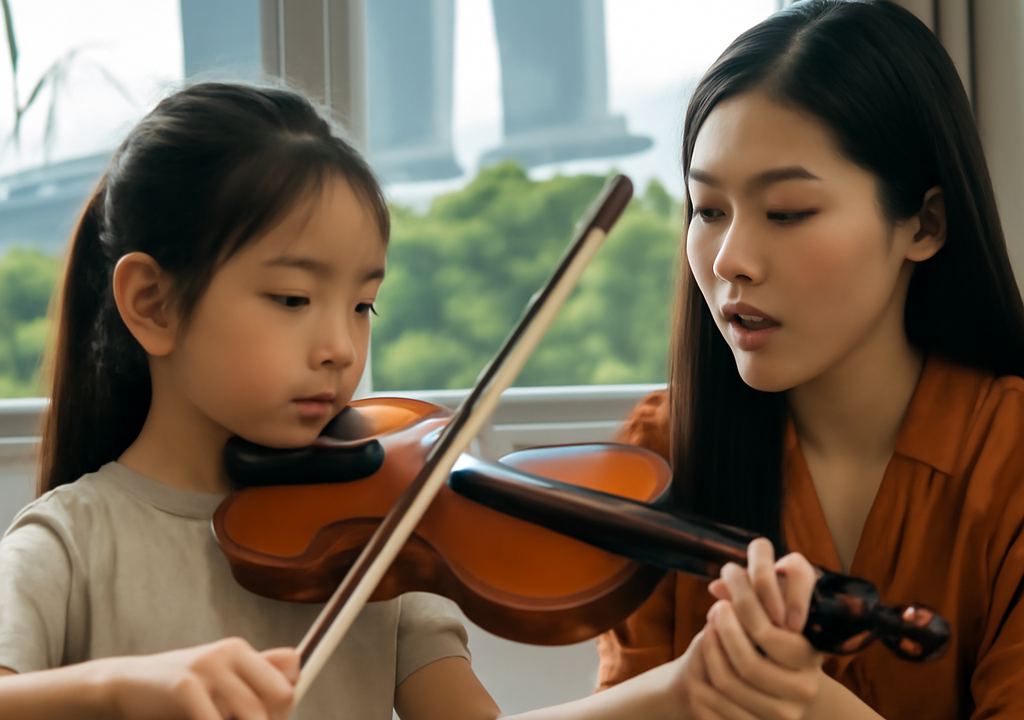
A private lesson lets the teacher fix bow hold, posture and intonation in real time — essential on an instrument where small errors quickly become hard-to-break habits. This is the standard and most effective route for serious violin learning, and it is the most expensive per hour.
Group lessons
Group violin classes, including ensemble or orchestra-style settings, keep costs down and add the joy of playing with others. They work well as a supplement, but for a beginner a group alone offers too little individual correction to build clean technique. Many learners pair private lessons with a group or ensemble.
Home (mobile) versus studio
Some teachers travel to your home, which is convenient and means the child practises in their own space; expect a small travel premium and tighter scheduling. Studio or school lessons often offer ensemble opportunities, performance spaces and a focused environment, but you handle the commute. Either way you will need your own correctly sized violin to practise on.
Choose by age and stage: kids, adults and beginners
Match the teacher’s experience to the learner, as violin teaching for young children differs sharply from teaching adults.
Young children
Violin is one of the few instruments commonly started very young, sometimes from age four or five, often using a method-based approach that emphasises listening and imitation. Look for a teacher experienced with little ones who is patient about posture and uses fractional-size violins. Crucially, young beginners usually need a parent to support daily practice at home.
School-age children working towards exams
Once a child reads music and holds the instrument confidently, a graded exam pathway adds structure and milestones. A teacher’s experience preparing students for grades — and their ability to balance exam pieces with enjoyable repertoire — both matter here.
Adult beginners and returners
Adults can absolutely start violin, though they should expect the early intonation and bowing stages to take patience. Look for a teacher comfortable with adult learners who sets realistic goals, whether that is folk tunes, classical pieces or playing in a community ensemble.
Graded exams: ABRSM and Trinity, explained factually
Most structured violin learning in Singapore follows a graded exam pathway. The two best-known boards are ABRSM (Associated Board of the Royal Schools of Music) and Trinity College London. Both offer practical grades, typically from an initial or preparatory level up through Grade 8, with diploma levels above for advanced players.
Graded exams are optional but useful: they provide clear milestones, a recognised certificate and a structured curriculum. ABRSM practical violin exams generally combine set pieces with scales and arpeggios, sight-reading and aural tests, and from a certain grade onwards a separate music-theory grade is usually required before progressing to higher practical grades. Trinity offers some flexibility in its components. Neither board is inherently “better” — what counts is that the teacher knows the syllabus and prepares students thoroughly. Ask any prospective teacher how they approach exam preparation and whether they enter students only when genuinely ready, rather than pushing grades too soon.
What to look for in a good violin teacher
A handful of concrete signals separate a strong violin teacher from an average one.
- Qualifications: a teaching or performance diploma (such as an ABRSM or Trinity diploma) or a music degree is a strong baseline, though rapport and the ability to teach posture clearly matter just as much.
- Exam track record: ask how their students have progressed across grades and whether they prepare both practical and theory components.
- Performance opportunities: ensembles, orchestras and recitals are especially valuable for violinists, building both confidence and the ear for playing in tune with others.
- Instrument fit: for children, the teacher should help you choose the correct fractional violin size and reassess as the child grows, since a wrongly sized instrument harms technique.
- Practice support: clear practice notes and, for young children, guidance for the parent who supervises home practice — the single biggest factor in early violin progress.
Typical price tiers in Singapore
Violin lesson fees in Singapore vary by the teacher’s experience, lesson length and whether they travel to you. The ranges below are qualitative guides for budgeting — always check current rates directly, as they differ by area and change over time.
- Entry tier: roughly $35–$50 per half-hour lesson, typically a newer teacher, group settings or beginner programmes. A budget-friendly way to start.
- Mid tier: roughly $50–$85 per 45-minute to one-hour private lesson with an experienced, diploma-holding teacher. This is where most committed students sit.
- Premium tier: $95 and upwards per hour for highly qualified teachers, advanced or diploma-level coaching, or established studios. Home lessons usually add a small travel premium.
Many teachers bill per term rather than per lesson, and some add a registration or material fee, so ask for the full cost before signing up. Remember to budget separately for renting or buying a violin and for periodic upsizing as a child grows. Compare lesson length and teacher experience, not just the headline rate.
Related guides
- Education & Enrichment in Singapore: The Complete Guide
- Best Drum Lessons in Singapore (2026 Guide)
- Best Piano Lessons in Singapore (2026 Guide)
- Best Guitar Lessons in Singapore (2026 Guide)
- Music Lesson Prices in Singapore (2026 Guide)
Frequently asked questions
How much do violin lessons cost in Singapore?
Most private violin lessons fall between roughly $35 and $95 or more per session depending on lesson length and the teacher’s experience, with home lessons carrying a modest travel premium. Group and beginner programmes sit at the lower end. Confirm current rates, term billing and any registration fees with the teacher or school directly, and budget separately for the instrument.
What age should a child start violin lessons?
Violin is often started young, sometimes from four or five, using method-based approaches that emphasise listening and imitation. Readiness, attention span and a parent’s willingness to support daily practice matter more than a fixed age. A good teacher will advise honestly whether a child is ready and which fractional size suits them.
Do I need to buy a violin before lessons, and what size?
You need a violin to practise on, but for children you should buy or rent the correct fractional size for their arm length rather than a full-size instrument. Renting is common because children outgrow sizes. Ask your teacher to confirm the right size before you purchase, and reassess as the child grows.
Is violin harder to learn than piano?
Violin has a steeper early curve because there are no frets to guide intonation and the bowing hand takes time to coordinate, so beginners spend longer before sounding “tuneful”. With consistent practice and good teaching this passes, but it is why private lessons and parental support in the early stages matter so much.
How do I find a good violin teacher near me?
Start by browsing the music schools category on WhitePages.sg, then shortlist by area, lesson format and price tier. Ask about qualifications, exam track record, performance opportunities and trial lessons before committing. You can also explore the full WhitePages.sg directory for nearby options.
Should I rent or buy a violin as a beginner in Singapore?
Renting is often sensible for young children who outgrow fractional-size violins quickly, while adults usually buy a full-size instrument. Many music shops in Singapore offer rental or trade-in schemes. Whichever route you take, ask your teacher to check the instrument is properly set up, as a poorly adjusted bridge or strings makes learning much harder.
How long should a beginner practise violin each day?
Young beginners can start with short daily sessions of around 15 to 20 minutes, building up as concentration improves. Older children and adults preparing for graded exams often practise longer. Regular, focused practice matters more than occasional long sessions. Ask your teacher for a weekly plan covering scales, pieces and technique so practice time is used well.
Are home violin lessons more expensive than studio lessons?
Home violin lessons in Singapore often cost a little more to cover the teacher’s travel time, though rates vary widely. As a guide, private lessons with an experienced teacher typically run roughly $50 to $85 for 45 minutes to an hour, with premium teachers charging $95 and upwards per hour. Studio lessons may offer access to better facilities and recitals.


